Designing a dining room for large family meals
A long table only works if the chairs, the serving surface and the walkways work with it. Here is how to plan the room around the way your family actually eats.
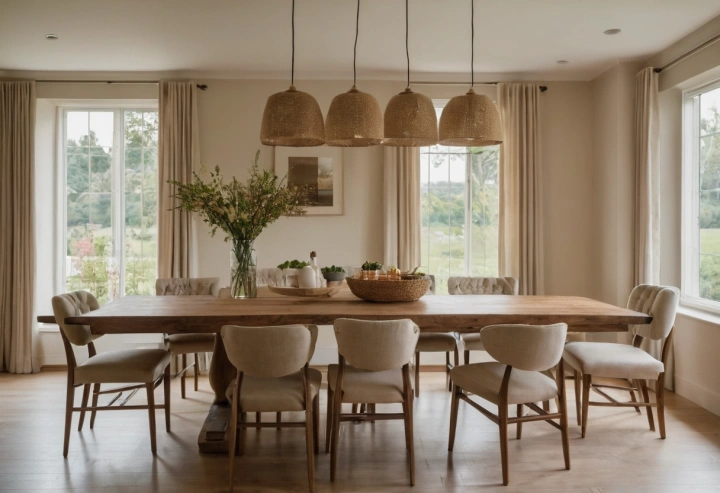
A dining room built for large family meals has to do several jobs at once: seat everyone comfortably, move hot food from kitchen to table without collisions, hold the extra bowls and plates that come out only on feast days, and stay pleasant to sit in for hours. Most rooms fail at one of those jobs rather than all of them. This guide takes the decisions in order, from the table outward, so the room works on an ordinary Tuesday and on the day the whole family arrives.
Start with the table, then measure the room around it
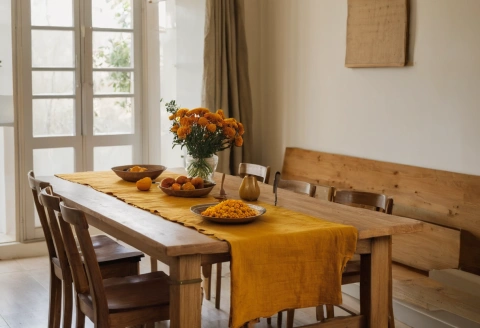
A long table suits Indian family meals better than a round one of the same footprint, because serving dishes can run down the center within everyone’s reach. An extendable table earns its keep in most houses: closed, it leaves the room open for daily life; open, it takes the holiday crowd. Before choosing one, check how the leaves store. Leaves that live in a closet under a stack of other things tend not to get used. Leaves that slide inside the table itself get used every time.
Then measure honestly. Set the table at its full length in your mind and walk the room. You want enough clearance behind a pulled-out chair for someone to pass carrying a full pot, roughly a hand’s width beyond the chair back at minimum, and more on the route from the kitchen door. That serving route matters more than symmetry. A table centered beautifully in the room but blocking the path from stove to seat makes every meal feel like a squeeze. For a closer look at choosing between fixed and extending tables, and at mixing floor seating for some family members, see a table for everyday and festive feasts.
Leg placement deserves a look too. Pedestal and trestle bases let you add chairs anywhere along the length; corner legs eat seats exactly where you need them when the table is extended. Run your hand along the underside edge: sharp aprons and low crossbars are what knees find first.
Seating that respects elders and children
Elders generally do best in firm chairs with armrests, at a height that lets feet rest flat and makes standing up a push rather than a climb. Very deep, soft, low seats look inviting and are hard to leave. Place those supportive chairs where the room is easiest to enter and exit, usually near an end or beside the main walkway, and away from the serving traffic so nobody bumps a shoulder mid-pour. If a grandparent prefers a cushioned floor seat for part of the meal, keep that spot near a wall or the sideboard for support getting up, and clear of the hot-dish route entirely.
Children need containment more than furniture. A booster with a strap or a stable high chair belongs at a spot where a grown-up sits within arm’s reach, not at the far end where supervision means standing up. Avoid placing small children directly beside heavy serving vessels or the tea tray. Matching chairs across the whole table looks tidy in photographs, but a mixed set, two armchairs at the ends, straight chairs along the sides, a bench on one flank, usually serves a real family better. A bench slides fully under the table when not needed and squeezes in extra cousins without ceremony.
Room for the food itself
Indian meals arrive as many vessels at once: a big pot of dal, a kadai of sabzi, rice, a stack of rotis under a cloth, chutneys and pickles in small bowls, yogurt, salad. The table needs a protected center zone for all of it, which argues for a table wide enough that place settings and serving dishes do not fight. Trivets and heat pads should live within reach of the table, not in a kitchen drawer across the room.
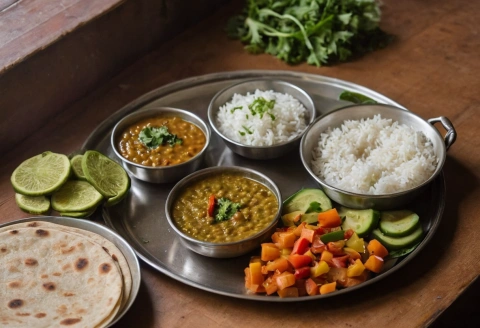
The bigger fix is a landing surface between the kitchen and the table. A sideboard, a console, even a sturdy cart positioned along the serving route lets you stage dishes in trips instead of juggling three hot vessels in one crossing. It also gives the meal a natural service pattern: cooking finishes to the sideboard, then to the table, and empties return the same way. If you serve thali style, with individual plates and small bowls arranged per person, the sideboard becomes the assembly line, and the layout matters even more; our guide to serving a thali style meal at home covers the plate and bowl logistics.
Size the sideboard by what it must swallow, not by what looks proportional. Measure your largest serving platter and your tallest pot, and check the interior depths against them. A beautiful shallow cabinet that cannot hold the biryani handi is decoration.
Light and sound for a full room
A crowded table generates heat, steam and conversation, and the room should be planned for all three. On light, layer rather than blast: a fixture centered over the table (not over the room, which shifts when the table extends), dimmable so the meal can linger, plus softer light elsewhere so the space does not feel like an interrogation. Warm-toned bulbs flatter both food and faces. Keep glare off the table surface; glossy tabletops under bare bright bulbs tire the eyes over a long meal.
On sound, hard rooms punish full ones. Tile floors, bare walls and glass turn a happy family dinner into a roar that elders with hearing aids find genuinely painful. Soft materials fix most of it cheaply:
- A rug under the table, large enough that chairs stay on it when pulled out.
- Curtains with some weight, even if they rarely close.
- Upholstered or padded-seat chairs instead of all hard wood.
- A bookshelf or textile on one wall to break up reflections.
Keep the cooking smells managed at the source. A dining room next to the kitchen benefits enormously from proper extraction at the stove; our piece on ventilation for spice cooking explains why tadka smoke should never reach the upholstery.
When a fuller classic design approach fits the house
Some houses ask for more than a good table and a sideboard. If the dining room is formal, connected to a living room with traditional detailing, or the family hosts often and wants the room to carry real occasion, a coordinated scheme, paneling, a substantial sideboard suite, matched lighting, drapery and furniture designed together, can be worth the investment. Studios working in classic interior design approach rooms this way, treating the dining room as architecture rather than a furniture arrangement.
The honest test is how the house lives. A family that eats most meals at a kitchen counter and uses the dining room mainly for festivals may prefer to spend on the table, the chairs and the acoustics, and keep the walls simple. A family whose dining room is the stage for every gathering, in a house with formal bones, gets lasting value from a full scheme. Either way, the functional decisions above come first. No amount of paneling rescues a table nobody can walk around.
Your next step
Before shopping for anything, host your next big meal with a notepad nearby. Note where people squeezed past each other, where a hot dish had nowhere to land, who struggled to stand up, and whether conversation required shouting. That single evening will tell you which fix your room needs first: the extendable table, the two supportive armchairs, the sideboard on the serving route, or the rug and curtains. Solve that one, then host again and take notes once more. A dining room for large family meals is built by iteration, one feast at a time.
Filed in Family Table. Read the editorial policy or send a correction.