Deep Drawers and Lid Racks for Big Pots and Pressure Cookers
Heavy steel pots and pressure cookers are awkward to store in standard cupboards. Deep drawers, a lid rack and one tall cabinet put them where your hands can reach.
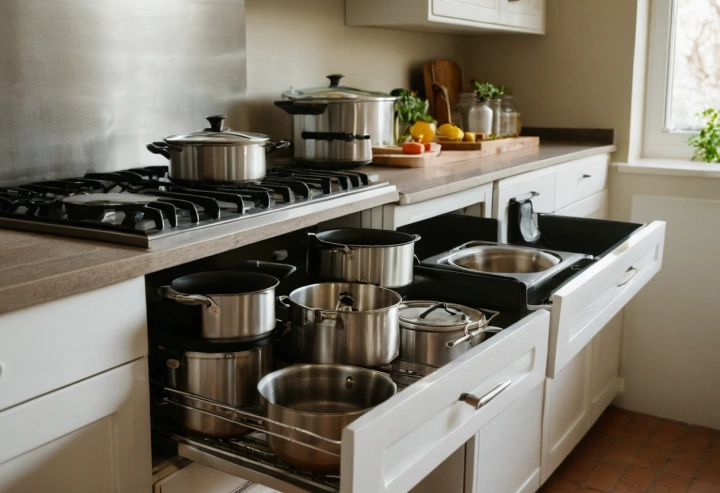
Big steel pots, a wide kadhai, the pressure cooker that runs almost every day: these make Indian home cooking possible, and they are the hardest things to store well. Standard base cupboards force you to kneel, reach into the dark back corner and lift a heavy pot over whatever is stacked in front of it. Here is a storage plan that fixes that: deep drawers for the heavy daily pieces, a proper home for lids, one tall cabinet for the occasional giants, hanging rails for what you grab mid-cook, and a simple rule for keeping everyday tools within arm’s reach of the stove.
Why deep drawers beat cupboards for heavy pots
A cupboard asks you to work blind. The pot you want sits behind two others, and lifting it means shifting the whole stack while bent at the waist. A deep drawer changes the geometry. Pull it out and you look down from above, see everything at once, and lift straight up with your legs doing the work instead of your lower back. For a full pressure cooker or a heavy-bottomed handi, that difference matters every day.
A few details make drawers work rather than merely exist:
- Choose full-extension slides so the back of the drawer comes all the way out past the cabinet face. A drawer that stops halfway recreates the cupboard problem.
- Check the weight rating of the slides before loading them with steel. Cookware is dense, and a drawer of pots weighs far more than a drawer of plates.
- Line the bottom with a thin non-slip mat so pots do not slide forward when the drawer opens.
- Store pots upright, nested only when they truly nest, with a cloth or felt disc between pieces you care about.
Give the widest drawer to the pressure cooker and its companions, the dal pot and the rice pot. Stand them side by side rather than stacked if the width allows. When you cook dal in a large pot most days, that pot should never live under anything else. If you are still planning, our guide to planning a kitchen renovation around how you actually cook covers how to list your real cookware before choosing cabinets, which tells you how many deep drawers you need.
Retrofitting drawers into existing cupboards
You do not need new cabinets to get most of this. Many base cupboards accept pull-out shelves or aftermarket drawer boxes on new slides, fitted behind the existing doors. A carpenter can convert a standard pot cupboard into two deep pull-outs in an afternoon. Measure the clear interior width and depth first, account for hinges that intrude into the opening, and confirm the cabinet floor is solid enough to carry the load. If the cupboard sits under the counter beside the stove, that is the best spot; spend the conversion money there first.
Lids deserve their own address
Lids cause more kitchen frustration than pots do. They are flat, slippery, mismatched in size and impossible to stack tidily, so they end up leaning against the back wall of a cupboard where they slide and clatter. Give them a dedicated spot and the whole system calms down.
The best solution is vertical storage: a rack of slots, like a file organizer, where each lid stands on edge. You see every size at a glance and pull one out without disturbing the rest. Racks fit inside a deep drawer beside the pots, inside a cabinet door, or in a shallow drawer of their own. Pressure cooker lids need extra thought because of the gasket and the weight valve. Store them upside down or on their side so the gasket is not compressed, and keep the gasket and whistle somewhere dry and visible rather than trapped under a lid where moisture lingers. A small tray in the lid drawer works well for gaskets, the safety valve and the little rack that comes with some cookers.
Match lids to pots loosely by zone rather than strictly by size. The daily lids live with the daily pots. The stockpot lid can live up high with the stockpot, since you fetch both together anyway.
One tall cabinet for the occasional giants
Every Indian kitchen has vessels that appear a handful of times a year: the enormous stockpot for a big family gathering, the wide kadhai for frying sweets at festival time, a tiered steamer, the extra idli stand. These do not deserve drawer space near the stove. They belong in a tall cabinet, ideally a pantry-style unit with adjustable shelves and pull-out trays at the lower levels.
Organize it by weight and frequency. Heavy and rare goes on the top shelf, where you will need a step stool but only rarely. Medium-weight pieces at shoulder height. Anything genuinely heavy that you use more than occasionally belongs on a pull-out tray at waist height, never overhead, because lowering a heavy pot from above your head is how wrists and toes get hurt. If the tall cabinet has room, dedicate one shelf to serving pieces for large meals; when the table extends for the whole family, you want the big platters and bowls fetched in one trip rather than several.
Label nothing, or label lightly. In a home kitchen you know your own vessels; the goal is visibility, not inventory. A pull-out tray you can see into beats a labeled box you cannot.
Hanging rails for the pieces your hand wants mid-cook
Some tools should never live in a drawer at all: the tawa that heats every morning, the small tadka pan for tempering, the ladle and skimmer you reach for while the dal bubbles. A wall rail with sturdy hooks near the stove keeps these in the air, in sight, grabbed without opening anything. Hang the tawa by its handle or lay it on a dedicated wall shelf; hang the tempering pan where splatter from the main burner will not constantly reach it.
Two cautions. First, anything hanging near the stove collects grease and spice-laden steam, so plan to wipe hung pieces more often than drawer pieces, and pair the rail with a hood that vents outside. Our piece on ventilation for spice cooking and high heat explains why capture at the stove makes every surface nearby easier to keep clean. Second, anchor rails into studs or solid masonry, not just drywall; a rail of steel pans carries real weight, and cast iron handles do not forgive a loose screw.
Keep the rail short and edited. A rail crowded with too many hanging items becomes visual noise and a cleaning chore. A handful of daily pieces is plenty.
The reach test for everyday pieces
The organizing rule underneath all of this: storage quality should match usage frequency. Stand at the stove and imagine making dinner. The pressure cooker, the dal pot, the tawa, the tempering pan, the salt and the everyday spices should all be reachable without walking more than a step or bending below the knee. Everything used weekly can live one zone away. Everything used seasonally goes high, low or far.
Run your own kitchen through this test honestly. If the pressure cooker currently lives under the sink because that was the only cupboard left, that is the single fix worth making first, even before any renovation. Swap it with the casserole dish you use twice a year. Kitchens drift into bad arrangements gradually, and a quick reshuffle often buys more daily comfort than new hardware.
Start with one drawer this week
Pick the cupboard nearest the stove that holds your heaviest daily pots. Empty it completely, wipe it out, and sort the contents into three piles: daily, weekly, seasonal. The seasonal pile moves to a high shelf or the back of a tall cabinet today. Then decide whether the emptied cupboard gets a pull-out conversion or whether its contents simply move into a better drawer you already have. Fit a lid rack wherever the lids will stand upright, even if it is a repurposed desk organizer for now. Live with the new arrangement for a couple of weeks, notice what your hand still searches for, and adjust. Storage for big pots is not a puzzle you solve once on paper; it is a small set of decisions you refine at the stove, one dinner at a time.
Filed in Kitchens. Read the editorial policy or send a correction.